
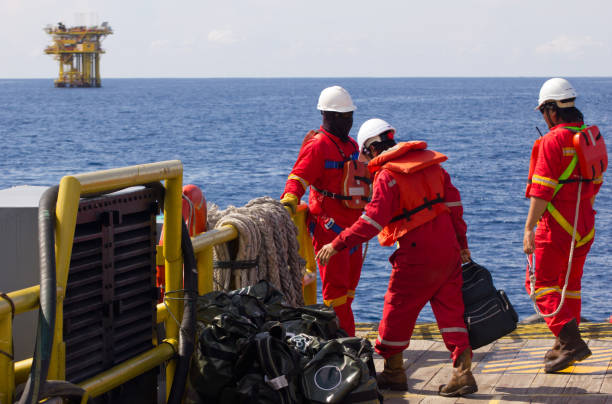
Working on an offshore energy platform off the coast of Alabama presents an intense environment. Operators, technicians, and riggers manage heavy machinery, high-pressure lines, and volatile substances miles from land. When a mechanical failure, catastrophic fire, or equipment malfunction causes an injury, determining which legal framework applies becomes an immediate priority.
The offshore energy sector operates under a complex network of federal statutes and maritime doctrines. An injury sustained on a fixed platform three miles off Dauphin Island falls under a completely different set of rules than an injury occurring on a moving vessel in Mobile Bay. The Outer Continental Shelf Lands Act establishes the jurisdictional and legal framework that governs these fixed offshore operations.
What Is the Outer Continental Shelf Lands Act?
Congress passed the Outer Continental Shelf Lands Act, codified at 43 U.S.C. § 1331 et seq., to establish federal control over the vast mineral and energy resources lying beyond state territorial waters. The statute grants the federal government administrative oversight over offshore leasing and operations, primarily managed today by agencies like the Bureau of Ocean Energy Management and the Bureau of Safety and Environmental Enforcement.
Beyond energy leasing, the statute establishes a detailed legal regime governing personal injury and wrongful death claims on fixed offshore structures. When a worker suffers harm on a stationary platform attached to the ocean floor, this act defines which court has jurisdiction, which laws govern liability, and what compensation systems provide relief. Key structural components of this federal law include:
- Extension of federal sovereign jurisdiction to the subsoil, seabed, and fixed structures attached to the Outer Continental Shelf.
- Adoption of adjacent state civil laws as surrogate federal law when no direct federal statute or regulatory rule applies.
- Integration of statutory workers’ compensation benefits for non-seamen platform workers.
- Preservation of traditional maritime personal injury rights for qualifying vessel crew members.
Where Does the Outer Continental Shelf Begin off the Alabama Coast?
Understanding geographic boundaries is critical for determining whether state law or federal statutory authority applies to an offshore accident. Under federal law, individual coastal states hold title and ownership over submerged lands extending a specific distance from their coastline. For Alabama, as well as Mississippi and Louisiana, state territorial ownership extends exactly three nautical miles seaward from the baseline of the coast. Florida and Texas maintain a nine-nautical-mile state boundary along the Gulf Coast due to historical statutory exceptions.
Once an offshore structure sits past that three-nautical-mile line in federal Gulf of Mexico waters, such as in active oil and gas lease blocks south of Mobile County and Baldwin County it rests firmly on the Outer Continental Shelf. An injury occurring on a platform inside the three-mile mark falls under standard Alabama state court jurisdiction or traditional general maritime law. An injury on a fixed jacket located four miles offshore brings the Outer Continental Shelf Lands Act into effect.
Who Is Covered Under the Outer Continental Shelf Lands Act?
OCSLA covers non-seamen personnel working on fixed platforms or attached structures on the Outer Continental Shelf who are involved in natural resource exploration, development, or extraction. Covered workers include platform operators, offshore electricians, catering staff, mechanics, and third-party maintenance contractors.
The statutory coverage of the Outer Continental Shelf Lands Act depends on both the physical location of the incident and the nature of the worker’s employment duties. To qualify for coverage under the statutory compensation provisions of the act, an individual must suffer an injury occurring as the result of operations conducted on the Outer Continental Shelf for the purpose of exploring for, developing, removing, or transporting natural resources from the subsoil or seabed.
This framework protects a wide array of specialized offshore personnel who keep energy production facilities running daily. Workers commonly covered under this federal statutory structure include:
- Offshore production operators and platform technicians.
- Roustabouts, riggers, and crane operators stationed on fixed jackets.
- Platform mechanics, instrumentation specialists, and electricians.
- Catering, galley, and laundry personnel employed on fixed living quarters.
- Third-party mud loggers, wireline specialists, and completion contractors.
- Pipeline inspectors and maintenance divers servicing attached subsoil infrastructure.
The statutory compensation protections do not extend to government employees or to traditional crew members of vessels who qualify for seaman status under federal maritime law.
How Does Alabama State Law Apply on Offshore Platforms Under OCSLA?
Under OCSLA, federal statutory law adopts the civil laws of the adjacent coastal state such as Alabama, as surrogate federal law on fixed platforms. These state laws apply to the extent they are applicable and not inconsistent with federal laws or administrative safety regulations.
Because fixed offshore platforms function legally as artificial islands located outside traditional state boundaries, Congress faced a challenge regarding which civil laws should govern day-to-day personal injury disputes, premises liability, and contract enforcement on these structures. Under 43 U.S.C. § 1333(a)(2)(A), the statute solves this by adopting the civil and criminal laws of each adjacent state as surrogate federal law.
For fixed platforms located on the Outer Continental Shelf off the coast of Mobile or Baldwin County, Alabama state law fills the gaps where federal law remains silent. This surrogate state law doctrine means that Alabama civil legal principles apply to platform personal injury claims, provided three specific conditions are met:
- The injury occurred on a structure covered by the Outer Continental Shelf Lands Act.
- Maritime law does not apply of its own force (since fixed platforms are artificial islands, traditional maritime law generally does not apply directly to platform premises liability).
- The adjacent state law is not inconsistent with federal law or federal safety regulations issued by agencies like the Bureau of Safety and Environmental Enforcement.
Under this provision, Alabama state law principles regarding personal injury damages, comparative fault, premises liability, and third-party negligence dictate the legal standard in federal court.
What Benefits and Compensation Are Available to Injured Platform Workers?
Injured platform workers receive automatic medical coverage and disability wage payments through the Longshore and Harbor Workers’ Compensation Act. When third-party negligence causes an accident, workers can also recover full financial damages for pain, suffering, and lost earning capacity.
When a platform worker suffers an injury on the Outer Continental Shelf, relief is available through a dual-track recovery structure. First, the worker receives immediate, no-fault compensation benefits under the LHWCA framework extended by OCSLA. Second, if an entity other than the worker’s direct employer contributed to the hazardous condition, the injured individual can pursue a third-party civil personal injury lawsuit.
The statutory compensation track provides immediate financial relief without requiring the worker to prove employer fault:
- Full payment of all reasonable and necessary medical treatments, emergency transportation, surgeries, and physical rehabilitation.
- Freedom to choose an independent treating physician rather than relying exclusively on company-selected doctors.
- Temporary total disability payments calculated at two-thirds of the worker’s average weekly wage during recovery.
- Permanent partial or total disability benefits for lasting physical impairments or loss of earning capacity.
Through a secondary third-party personal injury claim, an injured offshore worker can pursue additional damages not covered by statutory workers’ compensation:
- Full reimbursement for lost past wages and future lost earning capacity
- Comprehensive compensation for physical pain, suffering, and emotional distress
- Recovery for permanent physical disability, disfigurement, or loss of enjoyment of life
- Compensation for spousal loss of consortium where permitted under applicable law
How Do Third-Party Negligence Claims Work After an Offshore Platform Accident?
While statutory law prevents workers from suing their direct employer for negligence, workers can file third-party personal injury lawsuits against platform owners, equipment manufacturers, or independent contractors whose failure to maintain safe equipment or adhere to safety protocols caused the injury.
Offshore energy platforms operate as highly congested multi-employer work environments. On a single fixed structure in the Gulf of Mexico, a platform owner, a primary operator, a drilling contractor, a crane service provider, and numerous specialized sub-contractors work alongside one another daily. While statutory compensation shields a worker’s direct employer from a common-law negligence suit, it does not shield third-party companies operating on the same platform.
Third-party negligence claims regularly arise from operational failures and mechanical hazards on offshore structures:
- A platform owner failing to maintain structural decks, leading to severe corrosion, grating collapses, or dangerous slip hazards.
- An independent crane contractor mishandling cargo transfers or exceeding safe load limits during offloading operations.
- Equipment manufacturers providing defective blowout preventers, faulty pressure relief valves, or unsafe safety switches.
- Third-party service companies failing to properly secure high-pressure lines or clear toxic gases during well-servicing operations.
Pursuing a third-party claim allows an injured worker to bridge the gap between basic workers’ compensation disability rates and the true lifetime financial cost of a debilitating offshore injury.
What Evidence Is Required to Win an Alabama OCSLA Claim?
Winning an OCSLA claim requires physical and documentary evidence, including BSEE incident reports, platform maintenance logs, witness statements, digital telemetry, equipment inspection records, and detailed medical records linking the injury to the offshore incident.
Building a strong personal injury claim after a platform accident demands quick action and detailed documentation. Offshore energy companies dispatch risk managers and corporate investigators to the scene immediately following an emergency. Securing independent evidence levels the playing field against corporate defense strategies.
Critical items of evidence required to establish liability and demonstrate damages in an OCSLA third-party lawsuit include:
- Official incident investigation reports from federal regulators, including the Bureau of Safety and Environmental Enforcement.
- Platform daily logs, job safety analyses, and hot-work permits issued prior to the incident.
- Equipment maintenance records, pressure testing logs, and third-party inspection certifications.
- High-resolution photographs or video footage showing the unmaintained platform condition or broken machinery.
- Direct testimony from co-workers, contract personnel, and eyewitnesses present during the shift.
- Comprehensive medical records from emergency trauma facilities, such as USA Health University Hospital in Mobile, detailing the physical trauma and long-term prognosis.
Preserving physical evidence before a platform owner modifies or repairs defective machinery is critical to proving fault under surrogate state law standards.
Where Are Alabama OCSLA Lawsuits Litigated and What Are the Deadlines?
OCSLA claims arising off the coast of Alabama are litigated in federal court, primarily at the John Archibald Campbell U.S. Courthouse in Mobile. Injured workers must file their personal injury lawsuits within the strict three-year maritime statute of limitations.
Because the Outer Continental Shelf Lands Act is a federal statute, federal district courts maintain original jurisdiction over civil actions resulting from offshore energy operations. For accidents occurring on federal blocks adjacent to Alabama’s coastal boundary, lawsuits are routinely filed and tried in the U.S. District Court for the Southern District of Alabama, located at the John Archibald Campbell U.S. Courthouse in downtown Mobile.
Timing is critical in offshore injury litigation. Under the Uniform Statute of Limitations for Maritime Torts, 46 U.S.C. § 30106, personal injury and wrongful death claims arising from offshore incidents must be filed within three years from the date the injury occurred. Missing this statutory deadline permanently blocks an injured worker from seeking judicial recovery. Initiating a timely legal investigation ensures that vital platform telemetry, maintenance records, and eyewitness testimony are formally preserved.
Contact Fuquay Law Firm for Experienced Offshore Injury Representation
If you or a family member suffered a serious injury on an offshore platform or energy installation off the Alabama coast, navigating federal jurisdiction and corporate defense tactics requires skilled legal advocacy. Attorney Richard W. Fuquay brings extensive knowledge in maritime law and offshore personal injury litigation to fight for the financial recovery you deserve. At Fuquay Law Firm in Mobile, Alabama, we handle complex offshore injury claims on a contingency fee basis. You pay no attorney’s fees or legal expenses unless we successfully recover financial compensation for your claim. We represent injured platform operators, mechanics, riggers, and contract personnel across the Gulf Coast.
To discuss your legal options and protect your rights after an offshore platform accident, contact us today for a free, confidential case consultation.
Frequently Asked Questions
1. Can an injured platform worker collect LHWCA benefits and file a lawsuit at the same time?
Yes. An injured platform worker can receive ongoing Longshore and Harbor Workers’ Compensation Act medical and wage benefits from their direct employer while simultaneously pursuing a third-party personal injury lawsuit against a negligent non-employer entity. Any financial recovery obtained through the third-party suit may be subject to a legal lien to reimburse the workers’ compensation carrier for benefits paid.
2. What happens if an offshore injury occurs on a mobile jack-up rig rather than a fixed platform?
If an injury occurs on a mobile jack-up rig, drillship, or semi-submersible that is capable of navigation, the worker may qualify for seaman status under the Jones Act rather than OCSLA. Determining whether a structure qualifies as a vessel in navigation requires analyzing the rig’s operational status, mobility, and the worker’s permanent employment connection to the unit.
3. Does Alabama law limit non-economic damages in an OCSLA third-party lawsuit?
When Alabama law applies as surrogate federal law on an OCSLA platform, general civil damages standards govern the recovery. Alabama does not impose statutory caps on compensatory non-economic damages such as pain, suffering, and mental anguish in standard personal injury lawsuits against third-party corporate defendants.
4. Can independent contractors working offshore receive compensation under OCSLA?
Yes. Independent contract personnel, specialized service technicians, and subcontractor employees injured while working on fixed platforms attached to the Outer Continental Shelf fall under OCSLA statutory protections. They are entitled to LHWCA benefits through their employer and retain the legal right to sue other negligent third parties on the platform.
5. How long does a federal OCSLA injury lawsuit take to resolve in Mobile courts?
The timeline for resolving an OCSLA injury lawsuit in the U.S. District Court for the Southern District of Alabama varies depending on case complexity, the extent of medical treatment required, and court scheduling. Complex offshore litigation involving multiple corporate defendants, federal agency investigations, and technical expert testimony typically takes between 12 to 24 months from the initial filing to final resolution or trial.
