
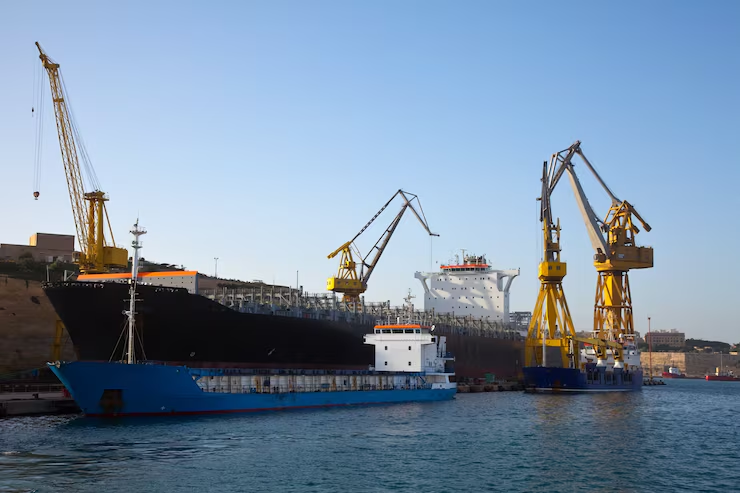
The sudden, violent shudder of an explosion or the rapid spread of flames across a steel deck is a nightmare no seaman ever expects. Whether you are navigating a massive cargo vessel through the busy shipping lanes of the Port of Mobile or working the heavy machinery on a commercial shrimp boat out of Bayou La Batre, the waterways of the Alabama Gulf Coast carry inherent, daily dangers. The ocean is an unforgiving workplace, and a catastrophic blast only magnifies those risks.
When a commercial vessel catches fire, the sheer kinetic energy and heat involved can end a maritime career in an instant. Hardworking men and women are often left with devastating physical injuries, severe thermal burns, and profound anxiety about their families’ financial survival. The moments after an accident blur together: alarms blaring, emergency protocols failing, hospital lights, and mounting medical bills.
What Are the Leading Causes of Commercial Vessel Fires and Explosions?
Commercial vessel fires and explosions frequently stem from poor engine room maintenance, defective fuel lines, improper storage of combustible cargo, and inadequate ventilation in confined spaces. When maritime employers delay necessary repairs or ignore safety protocols, the risk of a catastrophic onboard fire increases significantly.
The transition from the open waters of the Gulf of Mexico into structured shipping lanes requires intense focus and highly maintained equipment. A commercial vessel operates essentially as a floating industrial plant, filled with high-pressure boilers, massive diesel engines, and extensive electrical grids. Even a momentary lapse in equipment maintenance can trigger a thermal incident.
Most maritime crashes and fires stem from preventable hazards rather than unpredictable natural disasters. Routine inspections are vital to ensuring the safety of the crew. When companies prioritize profit over safety, workers inevitably suffer. In our experience representing clients, we see recurring patterns that lead to these catastrophic events. Common factors contributing to offshore blasts include:
- Electrical Shorts: Faulty wiring in damp, highly corrosive saltwater environments can easily spark fires in bulkheads or crew quarters.
- Engine Room Mechanical Failures: Ruptured high-pressure fuel lines spraying diesel onto uninsulated exhaust manifolds represent one of the highest risks for rapid ignition.
- Unsecured Flammable Cargo: Volatile materials shifting during rough seas can rupture containers, releasing hazardous vapors.
- Poorly Maintained Galley Equipment: Grease buildup and unchecked commercial stoves frequently lead to devastating localized fires.
- Confined Space Hazards: Failing to properly ventilate cargo holds or fuel tanks before sending deckhands in for cleaning allows explosive gases to accumulate undetected.
Investigating the exact cause requires acting swiftly before evidence disappears or the vessel undergoes repairs.
How Does the Jones Act Protect Burn Victims After an Offshore Blast?
The Jones Act protects injured seamen by allowing them to file a negligence lawsuit directly against their employer. If a maritime employer failed to provide adequate fire safety training, functioning extinguishers, or a safe working environment, they can be held financially liable for the resulting burn injuries.
Unlike land-based workers in Alabama who must rely on the standard state workers’ compensation system, maritime workers are protected under a specific federal statute. The Jones Act allows a seaman who suffers personal injury in the course of employment to bring a civil action against their employer. This is a fault-based system, meaning the injured worker must prove that the employer’s negligence played a part, no matter how small, in causing the injury.
The burden of proof under the Jones Act is notably lower than in standard personal injury claims. Even the slightest degree of employer negligence is enough to establish liability. If an employer failed to provide a safe workplace, and a fire breaks out, the employer is legally accountable. Common forms of Jones Act negligence in fire cases include:
- Failing to conduct mandatory fire drills or safety meetings.
- Ignoring reports from the engineering crew about fuel leaks or electrical issues.
- Operating the vessel with an insufficient number of crew members to handle emergencies.
- Supplying outdated, expired, or non-functioning fire suppression equipment.
- Ordering crew members to work in unsafe conditions during severe weather.
For an engineer trapped in a smoke-filled corridor, these administrative failures translate directly to life-altering physical trauma. Recovering under the Jones Act allows victims to pursue damages for past and future lost wages, medical expenses, and significant compensation for pain and suffering.
What Does the Doctrine of Unseaworthiness Mean for Explosion Claims?
Under general maritime law, vessel owners have an absolute duty to provide a seaworthy ship. If a fire or explosion occurs because of defective engine equipment, missing fire alarms, or an untrained crew, the vessel is considered unseaworthy, making the owner legally responsible for the crew members’ injuries.
Alongside a Jones Act negligence claim, injured seamen typically file a separate claim for unseaworthiness against the owner of the vessel. The legal concept of unseaworthiness does not mean the ship was in danger of sinking; rather, it means that some aspect of the vessel, its equipment, or its crew was not reasonably fit for its intended purpose. This is a strict liability standard, meaning you do not necessarily have to prove the owner knew about the defect only that the defect existed and caused your injury.
When a vessel moving through the Theodore Industrial Canal experiences a catastrophic blowout, investigators immediately scrutinize the mechanical fitness of the ship. Equipment failures are a leading driver of unseaworthiness claims. Conditions that render a vessel unseaworthy in the context of fires include:
- Absence of functioning smoke detectors or thermal sensors in critical areas.
- Hoses, pumps, or sprinkler systems that fail to deploy during an emergency.
- A lack of accessible emergency escape breathing devices (EEBDs).
- Blocked escape hatches or improperly marked exit routes.
- A crew that is insufficiently trained to combat onboard fires.
Untangling these corporate structures and establishing unseaworthiness requires meticulous legal strategy. Often, a single explosion involves a combination of both employer negligence and vessel unseaworthiness, allowing for a comprehensive approach to securing financial recovery.
Can I Receive Maintenance and Cure for Severe Burn Injuries?
Injured seamen are entitled to Maintenance and Cure benefits regardless of who caused the vessel fire. These no-fault benefits cover all reasonable medical treatments, including specialized burn unit care and skin grafts, alongside a daily stipend for living expenses until maximum medical improvement is reached.
After a maritime disaster, the immediate priority is survival and medical stabilization. Burn injuries require some of the most intensive, painful, and expensive medical care imaginable. Fortunately, general maritime law provides an ancient and powerful protection known as Maintenance and Cure. These are absolute, no-fault benefits provided to injured workers.
You have a legal right to choose your own medical providers. If your employer tries to force you to see a specific company doctor, you have the right to refuse. For severe thermal incidents occurring near the coast, victims often require treatment at specialized facilities like the University of South Alabama Health University Hospital regional burn center. Maintenance and Cure benefits cover:
- Emergency room stabilization and life-flight transportation.
- Skin graft surgeries, hyperbaric oxygen therapy, and reconstructive procedures.
- Long-term physical therapy and pain management medications.
- Psychological counseling for post-traumatic stress related to the explosion.
- A daily living stipend (Maintenance) to cover your rent, utilities, and food while you recover.
Your employer is legally obligated to pay these benefits until your physician determines you have reached maximum medical improvement (MMI). If a maritime employer wrongfully delays or denies these critical medical payments, they can be subjected to punitive damages in court.
What Evidence Is Vital Following a Cargo Ship Fire in Mobile Bay?
Building a strong injury claim after a maritime fire requires securing the vessel’s maintenance logs, federal inspection reports, and witness statements from fellow crew members. Photographic evidence of the fire damage and detailed medical records are also necessary to accurately prove liability and document damages.
The hours and days following a maritime fire are chaotic. However, preserving evidence is incredibly important for the success of your legal claim. Vessel owners and their insurance companies will have defense teams assessing the scene almost immediately. You need someone in your corner doing the exact same thing.
In many cases, incidents must be reported to federal authorities. The U.S. Coast Guard conducts thorough investigations into significant marine casualties, and their findings often play a central role in subsequent litigation. Securing the following evidence is critical to building a robust case:
- Vessel Logbooks: Maintenance records and engine room logs detail prior complaints or known mechanical defects.
- Safety Inspection Reports: Prior citations from the Occupational Safety and Health Administration (OSHA) highlight a history of non-compliance.
- Crew Testimony: Statements from coworkers confirm how the fire started and how the company responded to the emergency.
- Communication Records: VHF radio transcripts or emails demonstrating the captain’s knowledge of dangerous conditions.
- Physical Wreckage: In some circumstances, utilizing an in rem legal action allows an injured party to literally sue the vessel itself, arresting the ship to prevent it from leaving the jurisdiction before an inspection can occur.
Relying solely on the company’s internal investigation is a strategic mistake. Independent maritime investigators evaluate the burn patterns, electrical panels, and suppression systems to uncover the true cause of the disaster.
Who Can Be Held Liable for a Fatal Offshore Explosion?
Liability for a fatal offshore explosion may fall on the direct employer under the Jones Act, the vessel owner for providing an unseaworthy ship, or third-party equipment manufacturers. Surviving family members can pursue compensation for lost financial support and funeral expenses under general maritime law.
Tragically, the sheer force of a maritime explosion often results in fatalities. When a seaman loses their life while working at sea, the law provides specific avenues for the surviving family to seek justice and financial stability. Depending on the exact location of the accident, different legal frameworks apply.
If the fatal fire occurs within three nautical miles of the shore such as inside Mobile Bay or the Theodore Industrial Canal the family can pursue a wrongful death claim under the Jones Act and general maritime law. This allows spouses, children, and dependent relatives to recover damages for loss of financial support, loss of services, and the conscious pain and suffering the victim endured before passing.
If the disaster occurs further out in the Gulf of Mexico, beyond the three-mile territorial limit, the Death on the High Seas Act (DOHSA) comes into play. DOHSA allows families to recover purely economic damages. Identifying all liable parties is an essential step, which often include:
- The direct maritime employer for negligence.
- The vessel owner for breaching the duty of seaworthiness.
- Third-party contractors whose improper maintenance sparked the fire.
- Manufacturers of defective commercial marine equipment, such as faulty fuel valves or failing fire suppression systems.
It is very common in commercial incidents for multiple parties to share the blame. When this happens, courts apply the doctrine of comparative fault, distributing financial liability according to each party’s percentage of responsibility.
How Long Do Maritime Workers Have to File a Claim for Burn Injuries?
Under federal maritime law, injured seamen generally have three years from the date of the fire or explosion to file a personal injury lawsuit. Failing to initiate legal action within this strict three-year statute of limitations typically results in a permanent loss of the right to seek financial recovery.
Time is not on your side after a severe offshore injury. The legal window to hold a negligent employer accountable is strictly limited by federal statute. Under 46 U.S.C. § 30106, the standard statute of limitations for filing a maritime personal injury claim is three years from the date the accident occurred.
While three years might seem like a comfortable margin, waiting to secure legal representation is highly detrimental. As time passes, key witnesses transfer to different ships, memories fade, and physical evidence on the vessel is repaired or painted over. Furthermore, if you are attempting to negotiate with the vessel’s insurance provider on your own, they will purposefully drag out the process, hoping the statute of limitations expires before you file a lawsuit.
There are also rare exceptions where the filing deadline might be much shorter, particularly if the vessel is owned by a government entity. Moving quickly ensures that your legal team can preserve vital evidence, interview witnesses, and formally file your complaint in the appropriate court before your legal rights evaporate.
Where Are Federal Maritime Injury Lawsuits Filed in Alabama?
Most serious maritime injury and vessel explosion claims occurring on the Alabama Gulf Coast are filed in federal court. Specifically, these complex cases fall under the jurisdiction of the United States District Court for the Southern District of Alabama, located in downtown Mobile.
Because admiralty law is a highly specialized federal domain, the venue where your lawsuit is filed is a strategic decision that heavily impacts your case. Federal courts possess exclusive jurisdiction over certain types of maritime legal actions, particularly in rem proceedings where the injured party sues the vessel itself.
The United States District Court for the Southern District of Alabama has deep institutional experience handling maritime disputes. Federal judges in this district regularly interpret the nuances of the Jones Act and manage the complex discovery processes associated with major vessel fires and explosions.
However, under a legal provision known as the “saving to suitors” clause, injured seamen do have the option to file certain maritime personal injury claims in state courts, such as the Mobile County Circuit Court. Choosing between state and federal court depends entirely on the specific facts of your crash, the identities of the defendants, and the procedural advantages of each venue. Regardless of the chosen court, the judge must apply federal maritime law to decide the outcome, ensuring uniform protection for seamen.
Contact the Fuquay Law Firm for a Confidential Consultation
Pursuing compensation after a massive offshore explosion is a complex undertaking. Our highly regarded attorneys are dedicated to standing beside injured maritime workers and their families. We understand the physical toll of severe burn injuries and the intense financial pressure you are facing. We represent clients strictly on a contingency fee basis, which means you do not pay any attorney’s fees unless we successfully win your case.
Contact the Fuquay Law Firm today to schedule your free, confidential consultation and learn more about protecting your legal rights.
Frequently Asked Questions
1. Does the Coast Guard investigate commercial boat fires?
Yes, the U.S. Coast Guard conducts formal investigations into significant marine casualties, including commercial vessel fires. Their comprehensive reports analyze the cause of the thermal incident, verify safety compliance, and identify any breached regulations. These official findings often provide foundational evidence for subsequent Jones Act and unseaworthiness claims.
2. What happens if the fire destroyed the ship’s maintenance logbooks?
If onboard paper logbooks are destroyed in the blaze, your legal team will seek alternative documentation to prove negligence. This includes subpoenaing electronic maintenance records, emails from the captain to shoreside management, and past federal inspection reports. Witness testimony from the engineering crew also becomes a powerful tool to verify prior mechanical defects.
3. Will I have to pay out of pocket for my own skin graft surgeries?
No, you should not bear the cost of necessary medical procedures resulting from a maritime injury. Under the doctrine of Maintenance and Cure, your employer is legally required to cover all reasonable medical expenses related to the accident. This includes emergency stabilization, skin grafts, reconstructive surgeries, and ongoing physical therapy.
4. Can I sue if a defective engine part caused the offshore explosion?
Yes, you have the right to pursue a claim for damages. Defective engine components that lead to fires render the vessel unseaworthy, making the vessel owner liable. Additionally, you may have grounds for a third-party product liability lawsuit directly against the manufacturer who designed or produced the faulty equipment.
5. Does comparative fault apply if I accidentally started the galley fire?
Yes, maritime courts apply the doctrine of comparative fault when multiple parties share responsibility for an incident. If the judge determines your actions partially contributed to the fire, your final financial award will be reduced by your assigned percentage of fault. However, you remain absolutely entitled to Maintenance and Cure benefits regardless of your partial responsibility.
