
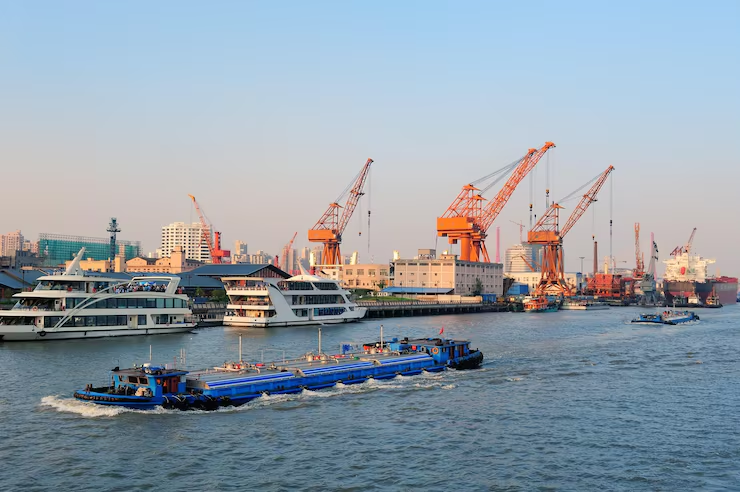
A deckhand stands on the wet steel plate of a spud barge moored along the Mobile River. Down the bank, harbor traffic from the Port of Mobile kicks up a sudden, irregular wake. The barge shifts hard against its mooring lines, causing a heavy winch cable to snap under sudden tension. The steel line strikes the worker, fracturing his leg and pinning him against the deck grating.
While recovering at USA Health University Hospital, he gets a call from his employer’s insurance adjuster. The message is blunt: because the barge was spudded down and stationary at the time of the collapse, it was not actively navigating. Consequently, the company claims he is barred from seeking recovery as a seaman and must settle for standard land-based workers’ compensation.
Does a Stationary Barge Qualify as a Vessel in Navigation Under Federal Law?
A stationary barge generally qualifies as a vessel in navigation under federal maritime law if it remains capable of water transportation. As long as a barge is floating, tied off, or anchored rather than permanently fixed to the land or permanently retired, courts consider it a functional maritime vessel. Federal statutory law defines a vessel as every description of watercraft or other artificial contrivance used, or capable of being used, as a means of transportation on water. The United States Supreme Court reinforced this baseline standard in Stewart v. Dutra Construction Co., holding that a watercraft remains a vessel in navigation unless it has been permanently rendered incapable of floating or moving across navigable waters.
For workers along Alabama’s Gulf Coast, this distinction is vital. A barge does not lose its legal status as a vessel simply because it is tied to a dock, secured by spuds driven into the riverbed, or anchored while supporting construction equipment. Unless a structure is permanently affixed to the shoreline, such as being encased in concrete as part of a permanent bridge pier it remains a vessel in navigation.
Maritime operations across Mobile County utilize several distinct types of stationary and semi-stationary barges:
- Spud Barges: Heavy steel platforms held in place by vertical steel posts driven into the mud, frequently used for marine construction and pile driving near the Port of Mobile.
- Crane and Dredge Barges: Floating platforms equipped with heavy machinery or lifting equipment used to clear channels or perform dock infrastructure repairs along the Mobile River.
- Deck Barges and Work Flats: Flat-surfaced structures used to store equipment, transport pipe, or serve as temporary work sites along the Theodore Industrial Canal.
- Hopper Barges: Unpowered vessels moored near grain elevators or coal terminals to hold bulk material before loading onto ocean-going ships.
How Does the Law Determine Seaman Status on Moored or Anchored Barges?
To qualify as a Jones Act seaman on a stationary barge, a worker must satisfy the two-pronged Chandris test. The worker must contribute to the vessel’s mission and maintain a substantial connection in both duration and nature, typically spending at least 30 percent of their work time on the vessel. Qualifying for protection under federal maritime law depends heavily on worker classification. The Supreme Court established the definitive legal framework for seaman status in Chandris, Inc. v. Latsis. This decision created a two-pronged legal standard that courts apply to evaluate claims arising on stationary barges:
- Prong 1: Contribution to Function: The employee’s job duties must contribute to the function of the vessel or to the accomplishment of its legal mission.
- Prong 2: Substantial Connection: The employee must have a connection to a vessel in navigation (or an identifiable fleet of vessels under common ownership) that is substantial in both duration and nature.
To satisfy the duration requirement under Chandris, courts apply a general rule of thumb: an employee should spend at least 30 percent of their total work time in service of a vessel in navigation. A deckhand who spends six weeks working aboard a floating work flat moored near Mobile Bay easily clears this 30 percent threshold.
Furthermore, contributing to the vessel’s mission does not require actively steering a ship across open water. Handling mooring lines, operating deck winches, maintaining ballasting pumps, securing cargo, or raising spuds on a stationary platform all satisfy the functional contribution requirement under federal law.
Does the Nature of Your Work on a Stationary Barge Affect Your Claims?
Yes, federal appellate decisions require that a worker’s duties expose them to traditional hazards of the sea. Temporary land-based contractors performing isolated, discrete repairs on tied-up barges may be classified as shore-based harbor workers rather than Jones Act seamen under the nature requirement.
While spending 30 percent of work time on a floating barge satisfies the temporal requirement, federal courts also scrutinize the “nature” of the employment connection. Recent appellate rulings, including en banc decisions from the Fifth Circuit in Sanchez v. Smart Fabricators of Texas, emphasize that a worker’s connection to a vessel must regularly expose them to traditional maritime hazards.
This distinction separates true crewmembers from land-based workers performing temporary tasks on tied-up vessels. If a shore-side welder is hired by an independent contractor for a single two-day repair job on a barge docked at a shipyard along the Tensaw River, courts may view that work as a discrete land-based assignment rather than a substantial maritime employment connection.
Courts consider several key factors when evaluating the nature of a worker’s connection to a moored or anchored structure:
- Vessel Movement: Whether the worker’s assignment requires riding the barge when it is towed or moved between job sites along coastal waterways.
- Employer Relationship: Whether the individual remains employed by a land-based subcontractor or is permanently assigned to the vessel’s crew.
- Perils of the Sea: Whether the worker’s primary job duties are exposed to tidal shifts, wake swells, open water weather, and marine deck hazards.
What is the Difference Between Jones Act Claims and LHWCA Benefits for Barge Workers?
The Jones Act permits injured crewmembers to sue employers for negligence and recover full pain and suffering damages. The Longshore and Harbor Workers’ Compensation Act provides scheduled, no-fault workers’ compensation benefits for land-based dockworkers, though LHWCA Section 905(b) allows third-party lawsuits against negligent vessel owners.
Determining whether an injured worker falls under the Jones Act or the Longshore and Harbor Workers’ Compensation Act (LHWCA) dictates the legal remedies available. These two federal statutory schemes are mutually exclusive; a worker is either a Jones Act seaman or an LHWCA harbor worker.
Understanding how these federal systems compare is critical when evaluating an injury claim on a stationary platform:
- Jones Act Negligence Claims: Under 46 U.S.C. § 30104, injured seamen can file a direct lawsuit against their employer for negligence. The burden of proof is low; if employer negligence contributed to the injury in even the slightest degree, the employer is legally liable. Recoverable damages include lost past and future wages, medical costs, and compensation for physical pain and suffering.
- LHWCA No-Fault Benefits: Covered under 33 U.S.C. § 901 et seq., the LHWCA is a statutory workers’ compensation system for land-based maritime employees, including dockworkers, ship repairers, and longshoremen. Benefits pay for medical care and temporary wage replacement based on statutory caps, regardless of who caused the accident. Pain and suffering damages are prohibited.
- LHWCA Section 905(b) Vessel Negligence: If a land-based worker covered under the LHWCA is injured on a stationary barge due to the negligence of the vessel or its crew, Section 905(b) permits a separate third-party negligence lawsuit against the vessel owner.
What Legal Protections Exist if a Stationary Vessel is Unseaworthy?
General maritime law holds vessel owners strictly liable for unseaworthy conditions that cause worker injuries. If a stationary barge has defective mooring equipment, slick oil-slicked decks, inadequate lighting, or insufficient crew, the owner must pay full compensation regardless of who was at fault.
Beyond statutory Jones Act negligence, general maritime law provides an independent cause of action known as the warranty of seaworthiness. A vessel owner owes an absolute, non-delegable duty to maintain a vessel and all of its equipment in a reasonably fit condition for its intended use.
This duty of seaworthiness applies fully to stationary barges, spud flats, and floating dredges. Liability for unseaworthiness is strict; an injured seaman does not need to prove that the vessel owner acted negligently or had prior notice of the defect. If an unsafe condition on the vessel directly causes an injury, the owner is financially responsible.
Common unseaworthy conditions that cause severe injuries on stationary barges in Mobile County include:
- Defective Deck Hardware: Frayed tow lines, broken winches, rusted padeyes, or defective spud lifting mechanisms.
- Slippery or Obstructed Walkways: Deck plates covered in hydraulic fluid, diesel oil, or marine growth without non-skid coatings.
- Inadequate Safety Gear: Failing to supply proper personal protective equipment, safety harnesses, or adequate deck lighting for night shifts.
- Crew Incompetence or Understaffing: Operating a barge with too few crewmembers or understaffed shifts, forcing workers to handle heavy rigging alone.
Who Pays Medical Bills and Daily Expenses After an Injury on a Tied-up Barge?
Injured Jones Act seamen have an absolute right to Maintenance and Cure benefits, regardless of fault. Vessel employers must cover all necessary medical expenses including emergency treatment at facilities like USA Health University Hospital and provide a daily stipend until the seaman achieves maximum medical improvement.
Maritime law includes ancient statutory protections designed to safeguard injured crewmembers immediately following a shipboard injury. Maintenance and cure benefits are automatic and completely independent of employer fault or comparative negligence.
These vital financial protections consist of two distinct obligations:
- Cure Obligations: The maritime employer must pay for all reasonable and necessary medical treatments required to treat an injury sustained while in the service of the vessel. This includes emergency room care, surgical procedures, specialized physical therapy, prescription medications, and medical transportation. Employers cannot force workers to use company-selected physicians.
- Maintenance Stipends: The employer must provide a daily financial living allowance to replace the room and board the seaman would have received while working aboard the vessel. This daily payment continues until the injured worker reaches maximum medical improvement (MMI).
If an employer wrongfully refuses to pay maintenance and cure benefits to an injured deckhand or barge worker, courts can impose heavy financial penalties, including punitive damages and attorney fees.
What Types of Compensation Can Be Recovered for a Stationary Barge Accident?
Victims of stationary barge accidents can pursue comprehensive financial damages under the Jones Act. Recoverable compensation includes past and future medical bills, lost wages, loss of future earning capacity, physical rehabilitation costs, and significant financial compensation for physical pain, suffering, and mental anguish.
Heavy equipment, shifting cargo, and high-tension winches on stationary barges mean that accidents frequently cause catastrophic, career-ending injuries. Crushing trauma, spinal fractures, traumatic brain injuries, and severe joint damage can permanently prevent a worker from returning to physical labor.
Through a successful Jones Act negligence lawsuit or general maritime unseaworthiness claim, injured workers can seek comprehensive financial recovery across multiple damage categories:
- Medical Expenses: Full reimbursement for emergency medical transport, hospital stays at facilities like Mobile Infirmary or USA Health, surgical costs, and projected future physical therapy.
- Past Lost Wages: Direct compensation for all wages lost during immediate medical recovery following the accident.
- Loss of Future Earning Capacity: Financial recovery for the long-term difference between what the worker would have earned in their maritime career and what they can earn in light of their permanent physical restrictions.
- Pain and Suffering: Substantial monetary recovery for physical suffering, emotional distress, disfigurement, and loss of enjoyment of life resulting from the injury.
Protect Your Rights After a Stationary Barge Accident
If you sustained an injury working on a stationary barge, spud flat, or floating dredge in Alabama waters, do not accept an insurance adjuster’s quick dismissal of your seaman status. Corporate vessel owners and their insurers begin gathering evidence to limit their financial liability immediately after an accident occurs. Our knowledgeable maritime attorneys at Fuquay Law Firm represent deckhands, harbor workers, and seamen throughout Mobile, Baldwin County, and the Alabama Gulf Coast. We handle maritime injury claims on a contingent fee arrangement, meaning you pay no attorney fees or legal expenses unless we successfully secure financial compensation for you.
Contact us today to schedule a free, confidential case evaluation. Let our experienced legal team evaluate your claim, establish your seaman status, and fight for the maximum compensation you deserve under federal law.
Frequently Asked Questions
1. Is a floating crane barge tied to a pier considered a vessel in navigation?
Yes, as long as a crane barge remains floating and capable of being towed across navigable waters, it generally retains its legal status as a vessel in navigation. Temporary mooring or tying off to a dock does not strip a floating craft of its vessel status under federal law.
2. Can I receive Jones Act benefits if I was injured while the barge was tied to a dock in Mobile?
Yes, your location at the exact moment of an injury does not eliminate your rights as a Jones Act seaman. If your overall job duties satisfy the requirements for seaman status, you remain fully protected while performing deck work on a tied-up barge.
3. What happens if my employer claims I am an LHWCA worker instead of a Jones Act seaman?
Disputed worker classifications are common because Jones Act claims expose employers to higher financial liability. Our attorneys review your complete work history, job duties, and time spent on vessels to establish your proper legal status and fight for maximum recovery.
4. Can I choose my own doctor after being hurt on a stationary barge?
Yes, under federal maritime law, injured seamen exercising their right to Maintenance and Cure benefits have the absolute right to select their own treating physician. You are not required to treat exclusively with company-mandated doctors.
5. What if my injury on a spud barge was partially my own fault?
Federal maritime law applies the rule of pure comparative fault. Even if your own actions contributed to the accident, you are not barred from recovery; your financial compensation is simply reduced by your percentage of fault.
6. Where will my maritime injury lawsuit be filed in Alabama?
Most major maritime cases in coastal Alabama are filed in federal court at the John Archibald Campbell U.S. Courthouse in downtown Mobile. Depending on strategic considerations, some claims may also be pursued in state courts like the Mobile County Circuit Court.
